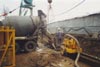
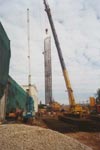
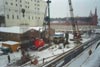
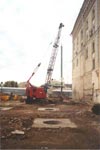
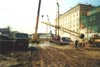
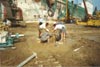
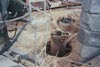
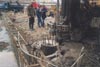
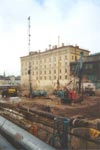
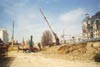
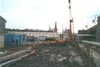
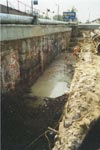
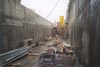
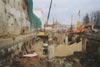
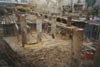
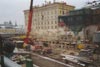
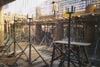
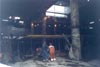
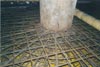
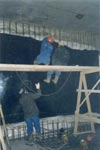
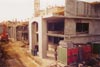
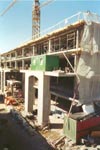
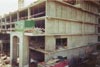
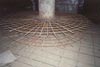
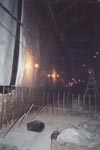
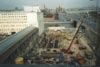
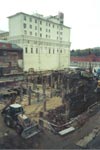
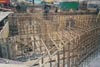
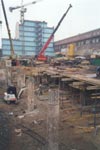
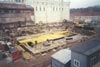
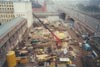
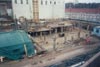
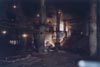
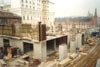
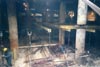
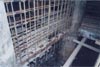
Permanent diaphragm walls, thickness 80 cm are made of concrete В25 by Italian technique with keyed joints between standard panels 2.5 meter wide and non-standard closing panels - up to 3.49 meter wide. The cages of bearing diaphragm walls were shaped in order to allow the easy formation of horizontal grooves for the connection of the floor slabs of two upper underground stores and of the foundation slab. Such zones were strengthened by additional reinforcing bars.
Temporary diaphragm walls, thickness 60 cm, separating each of construction three stages one from another, are made by the same method using lean concrete B7.5, and can be easily dismantled later. These walls were reinforced by reinforcing cages of new structure, specially developed by us for this purpose. To increase water resistance of the temporary walls a 30 to 50 mm layer of shotcrete provided with reinforcing mesh has been applied to the surface of the walls during the excavation.
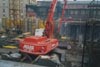
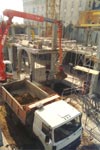
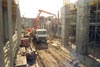
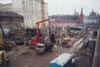
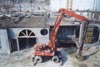
Between temporary heating by-passes and permanent diaphragm walls along Bolshoy Moskvoretzky Bridge an underground communications channel was built, after its back filling the main driveway was made on construction site for the cargo vehicles, cranes and earth cutting equipment.
As pit enclosure 6 meter deep under this channel we made use of vertical and inclined "jet"-columns, connected on top by in-situ reinforced concrete framing beam. The solution applied completely excluded temporary support of excavation pit and assured safety of works along operating heating line, where piping is quite sensitive to any displacements and settlements.
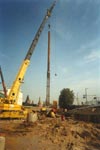
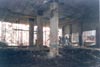
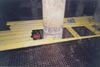
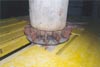
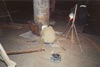
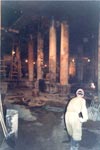
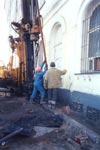
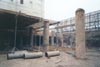
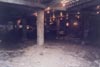
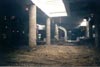
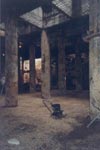
Bored columns, diameter 72/120 cm of В30 concrete, without which the project could not be implemented, have been constructed from site surface as permanent bearing structures not requiring any further strengthening or build up, except painting or decorative cladding
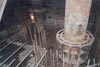
The accuracy of columns construction (inclination from vertical line not to exceed 1:500) was achieved by using own gravity force of whole reinforcing cages, diameter 720/980 mm while their centering in holes, diameter 1.2 m, bored under protection of bentonite slurry. Tolerance deviation of column caps with account to design of their joints with underground floor slabs and foundation slab has been achieved ± 100 mm.
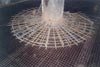
Every reinforcing cage contained one guide-pipe in order to allow the execution of a core boring under the column bottom for a subsequent accurate geological investigation to check the bearing capability of each single column. The cage also contained two pipes for additional injection of cement grout into the foot. 14 main operations made the whole technology of
bored column construction:
(FLASH-presentation: The technology of bored column сonstruction, 219 kb)
For jointing of
bored columns with underground floor slabs principally new, unified by design, simple and reliable joints were developed providing reliable operation at all construction phases, and being fire-resistant in operation of underground constructions.
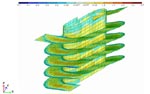
A horizontal jet-grouting curtain was made with the purpose of limiting water infiltration inside the pit during construction of Building 1 in the old river bed area where Neverovsky confining clays layer were not present. This jet-slab was executed at 20 meter depth from the working level by "jet-grouting" technology, has area over 1500 m
2 (DWF-drawing, 104 Kb).
This jet-grouting curtain allowed to complete the "zero-cycle" of Building 1 only with a perimetrical drainage ditch. The water inflow from all jet-slab area did not exceed 40 m
3/h including water leaking through the joints of the diaphragm walls panels.
Soil excavation in making pits 15 meter deep, for "zero cycles" of buildings is approved to be cut-and-cover excavation type at first tier and bulldozer excavation from second to fourth tier with permanent open-type pit water drainage. Tiers' height may be 3-4 m.
Along diaphragm walls and
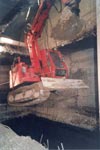
bored columns soils are excavated by compact "Bobcat" excavators, blocks of limestone are broken down by the same excavators with attachable hydraulic hammers. A perimetrical drainage ditch is dug at each excavation level to collect residual water in sumps with exhausting pumps operating at intervals when required.
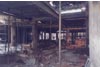
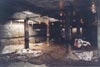
From the second tier of excavation is carried out under protection of underground floor slabs constructed by "top-down" method, as the pit receives additional loading from aboveground levels structures, constructed by "down-top" method. Soils delivery from under the floor slabs is executed by clamshell excavator "Atlas-1704" through erection openings, left in floor slabs low-level aboveground parts of buildings.
In-situ bearing structures of Multifunctional complex are constructed of concrete grades В30 and В25. Following "top-down" method during concreting of zero cycle floor slabs forms support through wooden joists on plastic soils, their surface being dried by ground drainage and is consolidated by ramming 15 cm of crushed limestone.
Starting from the second underground floor, the excavation and the construction of the underground structures are done in two stages: first in one half of the surface leaving a berm in the second half. Such sequence has been chosen in order to minimize the deformations of the surrounding ground mass and reduce negative effects on the neighbouring buildings and on the nearby bridge.
Waterproofing of underground space is made of geosynthetics and is made following the closed and continuous scheme ("aquarium" type) not providing for a permanent drainage under the foundation slab.
In order to ensure high reliability of waterproofing it is recommended to use its new structure with safety drainage layer and sectional systems of sealing of most vulnerable units.
The structure of waterproofing system consists of following layers:
geotextile with density of 800 g/m2, as external filter-bed;
geomembrane 2 mm thick from very flexible and light-stabilized polyethylene (VFPE), the strips of which are butt-welded with contact hot-air- or extrusion-method. All welded joints are 100% tested for continuity;
"Tensar" geonet 6.3 mm thick from polyethylene, forming a safety internal drainage layer;
geotextile with density of 550 ± 50 g/m2, as protective layer and internal filter-bed;
polyethylene film 0.16 mm thick that prevents penetration of safety drainage layer and internal filter-bed by cement milk during execution of cast-in-place reinforced concrete protective walls.
The reinforced concrete protective walls have 30 cm width and being designed to bear full-scale hydrostatic pressure. (Russian version, File PDF, 1076 Kb)
The combined construction method allowed to construct an eight-floor Building 1 with four underground floors during 12 month only, same construction period is planned for Buildings 3 and 2.
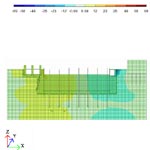
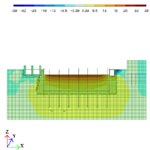
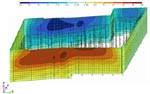
Structures' economical nature is due to conducted 3D static computer calculations with account to redistribution of stresses and deformations in progress of construction and operation